


Astrophotography in Namibia: Capturing the Milky Way Under the Darkest Skies
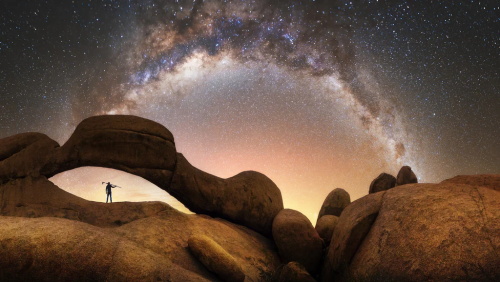
If you are a traveler who loves the night sky as much as photography, Namibia will take your breath away again and again. This young country in the southwest of Africa is famous not only for its ancient red deserts and unique wildlife but also for having some of the darkest and purest skies on Earth. For astrophotographers, Namibia has become a true sanctuary.
Here, under skies free from the heavy hand of light pollution, the Milky Way stretches across the heavens like a luminous river of stars. Against surreal backdrops such as quiver tree forests or crimson sand dunes, you can capture nightscapes that feel both alien and eternal. Namibia is not merely a place to take photographs; it is a stage where the Earth and the cosmos perform together in perfect harmony.
Namibia’s Unique Landscape and Its Role in Astrophotography
Namibia is home to the Namib Desert, often called the oldest desert on the planet. Unlike deserts such as the Sahara or the Taklamakan that sprawl across the continental interior, the Namib hugs the Atlantic coastline, forming a breathtaking “sea of sand” that stretches for over 1,600 kilometers.
In this extraordinary setting, you can literally stand with one foot sinking into scorching red dunes and the other splashing in the icy waters of the ocean. This juxtaposition of desert and sea is one of the most remarkable geographical experiences on Earth.
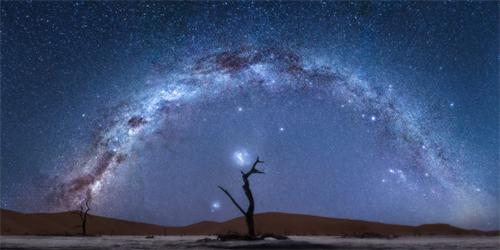
At the heart of this desert lies Sossusvlei, a dreamscape for photographers. Here, the high iron content in the sand gives the dunes their fiery, crimson glow when illuminated by sunlight. By day, the region resembles a stark painting of dunes, skeletal camel thorn trees, and salt pans. By night, however, Sossusvlei transforms into Africa’s first International Dark Sky Reserve.
In this kind of environment, the Milky Way and the Large and Small Magellanic Clouds appear vividly overhead. The dark dust lanes of the Milky Way become visible to the naked eye, and even without a telescope, the vastness and depth of the universe seem palpable.
Namibia offers astrophotographers conditions that are nearly unrivaled:
- Minimal light pollution: Nighttime brightness can fall below 0.001 lux—less than one percent of the light of a full moon.
- Crystal-clear atmosphere: The air is exceptionally dry and stable, with little humidity to distort starlight.
- Extraordinary foregrounds: From dunes and quiver trees to salt pans and prehistoric rock engravings, the land offers endless possibilities for creative compositions.
Best Seasons for Observing and Photographing the Milky Way
The prime astrophotography season in Namibia runs from May through October. This period corresponds to the Southern Hemisphere’s winter, when skies are dry, rainfall is rare, and the Milky Way’s galactic core rises almost vertically overhead. The result is a radiant river of stars spilling across the zenith.
During these months, the following celestial objects are particularly spectacular:
- The Southern Cross (Crux): Perhaps the most iconic constellation of the Southern Hemisphere, revered by the indigenous Herero people as a “guide of the soul.”
- Alpha Centauri (Rigil Kentaurus): The closest star system to our Sun, whose triple-star structure can be distinguished even with a modest telescope.
- The Magellanic Clouds: The Milky Way’s satellite galaxies, visible as faint glowing patches with the naked eye.
- Nebulae and clusters: The Eagle Nebula, Lagoon Nebula, globular clusters such as M22 and M4—all easily visible against Namibia’s dark backdrop.
Tips for Observation and Shooting:
- Plan sessions around new moon phases and avoid bright moonlight.
- The best time for shooting is two hours after sunset until one hour before midnight.
- Allow your eyes 20–30 minutes to adjust to the darkness.
- Use a star map app such as Stellarium to locate constellations and deep-sky objects.
Equipment and Shooting Recommendations
Capturing Namibia’s night sky in its full glory requires both careful planning and the right gear.
- Camera: A full-frame DSLR or mirrorless body works best, offering superior low-light performance and dynamic range.
- Lens: Ultra-wide lenses in the 12–14mm range are ideal. Prioritize fast apertures (e.g., f/1.8 or f/2.0) over ultra-wide angles with smaller apertures, as light gathering is crucial.
- Tripod and head: Stability is essential. A sturdy tripod ensures sharp results during long exposures.
- Settings:
- Aperture: Around f/2.8
- ISO: Between 3200 and 6400
- Shutter speed: About 30 seconds (to avoid star trailing)
- White balance: Around 4200K for a natural, slightly cool tone
Practical techniques:
- Focus on a bright foreground element (such as a quiver tree) using autofocus, then switch to manual to lock it.
- For panoramic Milky Way shots, overlap each frame by at least 30% for smoother stitching in post-processing.
- Consider shooting time-lapse sequences to show the rotation of the sky across the Namibian landscape.
Top Locations for Astrophotography in Namibia
1. Sossusvlei and the Red Dunes
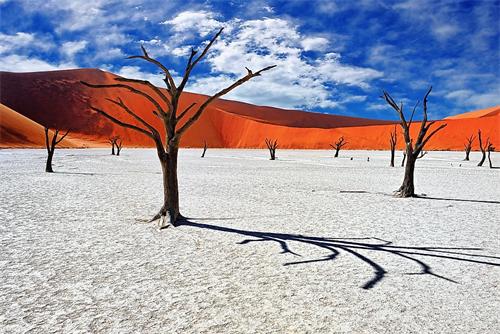
- Signature features: towering crimson dunes, the skeletal trees of Deadvlei, and a pristine night sky.
- Accommodation tip: Sossus Dune Lodge, located within the park boundaries, allows access to the dunes for stargazing even before sunrise or after sunset.
2. Quiver Tree Forest near Keetmanshoop
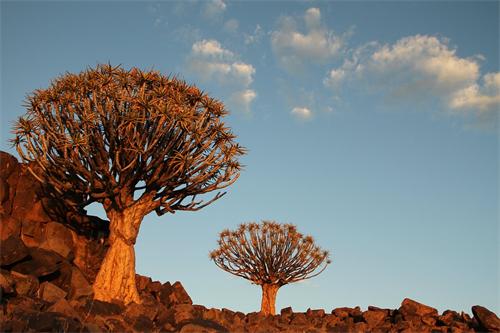
- Located about five hours by car from Windhoek, this is the world’s densest population of quiver trees.
- The alien-looking silhouettes of these ancient succulents make them ideal for foreground compositions.
3. Twyfelfontein Rock Engravings
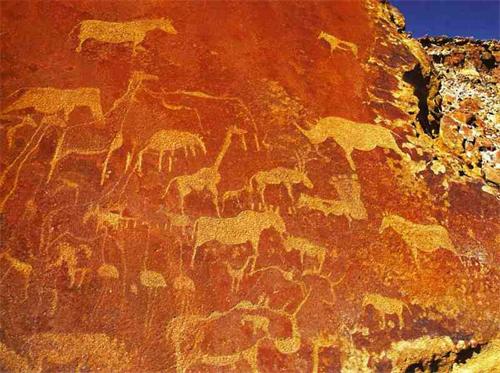
- A UNESCO World Heritage Site where prehistoric people carved constellations and hunting scenes into the rocks.
- Here, astrophotography becomes not only an artistic pursuit but also a cultural and historical dialogue with the past.
The Cultural Dimension: Where Sky Meets Story
Namibia’s skies are not just a scientific wonder; they are also woven into the cultural fabric of the region. At Twyfelfontein, rock engravings dating back thousands of years show that early humans were already mapping the heavens.
Among the Himba people, who still live in remote northern villages, traditional customs are deeply intertwined with nature. They coat their skin with a mixture of ochre and butterfat, which gives them a reddish glow, symbolically uniting their bodies with the colors of the earth and sky.
Visitors who wish to experience Himba life should do so respectfully:
- Always visit with a local guide.
- Ask permission before taking photographs.
- Small gifts such as sweets or household items are appreciated, but avoid handing out money directly.
Namibia by Day: More Wonders Beyond the Night
Although astrophotography may be the focus of your trip, Namibia’s daytime landscapes are equally unforgettable.
- Walvis Bay: A coastal lagoon where thousands of flamingos wade and feed, turning the shoreline into a sea of pink. The cooler, wetter climate here contrasts sharply with the arid desert inland.
- Etosha National Park: Spanning more than 22,000 square kilometers, this reserve shelters Africa’s “Big Five” (lion, leopard, elephant, rhino, buffalo), as well as giraffes, zebras, springboks, and oryx. The combination of wildlife viewing by day and star trails by night makes Namibia a photographer’s paradise.
Practical Travel Tips
- Currency: The Namibian Dollar (NAD) is the official currency, though U.S. dollars and euros can be exchanged widely. Everyday expenses and tipping are typically done in NAD.
- Transport: Renting a high-clearance vehicle is strongly recommended, as many desert roads are unpaved and dusty.
- Sun protection: With over 300 days of sunshine a year, pack sunscreen, sunglasses, a wide-brimmed hat, and scarves.
- Temperature: Be prepared for drastic temperature swings between day and night. Warm layers are essential for nighttime shoots.
- Local customs: When encountering religious or cultural practices, remain quiet and respectful.
The Emotional Impact: A Dialogue with the Universe
Standing beneath Namibia’s skies, you come face to face with your own smallness. By day, you climb dunes that have endured for 80 million years; by night, you lie beneath a galaxy that has burned for billions. The juxtaposition creates an experience that is not only visual but profoundly spiritual.
Astrophotography here is not just about capturing stars—it is about capturing perspective. Whether you frame the Milky Way arching over quiver trees, or shoot star trails spinning above a Himba village, each image becomes a reminder of the resilience of life and the vastness of the cosmos.
Namibia is more than a destination. It is an invitation to slow down, to look upward, and to realize that the same stars ancient people carved into rocks still blaze above us today. If you are ready to carry your camera into the desert, Namibia will reward you with an unforgettable gift: your very own piece of the galaxy, captured under the darkest skies on Earth.
Recommended for you: