


Bukhara, Uzbekistan: Exploring the Ancient Silk Road City of a Thousand Years
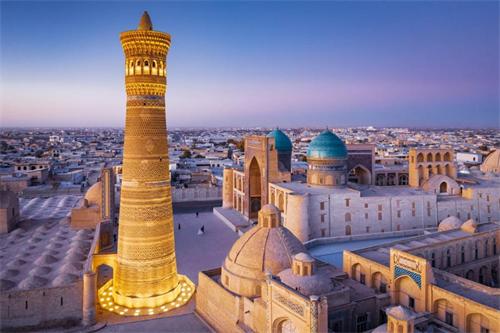
In the vast lands of Central Asia, there is a city that stands quietly, where a thousand years of history have settled—this is Bukhara, often called "the Pearl of Central Asia." It is not just an ancient city, but a legend that spans across time. It is the hometown of the folk hero Afanti, bears the glorious history of the Samanid dynasty, and is home to the “Lighthouse” in the desert—the Kalyan Minaret, symbolizing supreme royal power. Located in western Uzbekistan, Bukhara is a land full of legend, with a history that can be traced back 2,500 years, making it one of the oldest cities in Central Asia.
As a key hub on the ancient Silk Road, Bukhara was once a crossroads for Eastern and Western cultures, religions, and trade. Walking through the streets of Bukhara feels like stepping into a bustling marketplace a thousand years ago: merchants gathered, scholars debated, and religious traditions mingled. The city’s history is not only one of wars and conquests but also of cultural prosperity. Islamic scholars established numerous madrasas and mosques here, making Bukhara an academic center in the Islamic world. The manuscripts, books, and architecture within the old city all testify to its rich cultural heritage, which is why Bukhara is also called “the city-museum of Central Asia” and forms an important part of the world cultural heritage.
Beyond its cultural heritage, Bukhara’s architecture is equally astonishing. Narrow alleys, ancient brick buildings, and intricate mosaics make visitors feel transported to the Middle Ages. Its bazaars, markets, and religious sites have largely retained their original forms, becoming a major draw for travelers.
Entering a City of One Thousand and One Nights
I first heard of Bukhara in the Central Asia volume of Lonely Planet. The cover showed a light-blue mosque with four small towers, dreamlike and magical, almost like a fairy-tale castle. At that time, I didn’t know that this was Chor Minor, one of Bukhara’s most famous landmarks.
The first time I actually entered Bukhara, it was at dusk. The slanting sun bathed the yellow-brick walls, the dry air felt like the turned page of an ancient book, and footsteps echoed through domes and arcades. In that moment, I didn’t feel like I was “traveling”—I felt as if I had walked into a living One Thousand and One Nights. This is Afanti’s hometown, a city once visited by Persian storytellers, a place of merchants’ inns, scholars’ lectures, and nobles’ councils. Now, all the past splendor has faded—only the yellow earth, the chirping of birds, patches of sunset, and stories waiting to be heard remain.
Though Bukhara has 140 historical buildings, the main areas for visitors are concentrated in the old city. Combined with the Emir’s summer palace on the outskirts, a 2-day itinerary is perfect. The best way to explore is by city walk, as most attractions are within walking distance.
Chor Minor
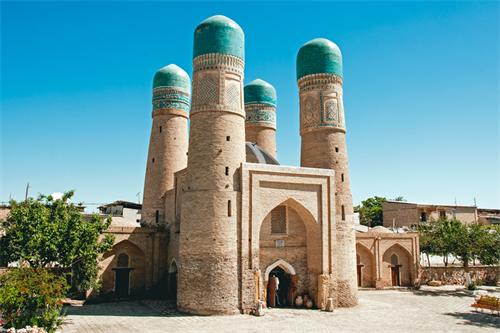
Unlike grand minarets or magnificent prayer halls, Chor Minor is small, delicate, and strangely soothing—like a scene from a fairy tale. The four towers seem like guardians; some say each represents different faiths or cultural symbols, while others say they are purely decorative.
Ticket: 5,000 UZS
Poi Kalon Complex
This is the soul of Bukhara, consisting of the Mir-i-Arab Madrasa, Kalon Mosque, and the 48-meter-high Kalon Minaret. The Kalon Minaret, built in 1127, is the only building that Genghis Khan did not destroy during his Central Asia campaign. Legend has it that when he entered the square, his hat was blown off by the wind. As he bent to pick it up and looked at the minaret, he felt small and ordered it to be spared.
The Mir-i-Arab Madrasa is still in use and is exquisitely decorated, though the interior is open only to Muslims.
Ticket: 5,000 UZS
Lyabi-Hauz Square
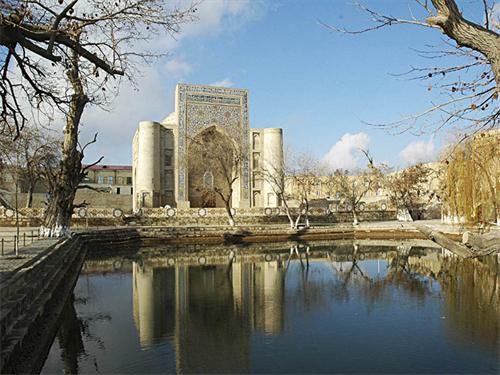
Not far from the minaret complex is Lyabi-Hauz Square, a favorite evening gathering place for locals. The square centers around a 16th-century pond, with people sipping tea by its edge, children chasing pigeons, and a statue of Afanti under the shade of trees. Growing up, we all read stories of the clever, mischievous old man riding a donkey—but standing here, I realized Afanti was not fictional. He represents the humor and wisdom that grew from this land, a spiritual legacy Bukhara bestowed upon Central Asia. This ancient, solemn city needs an Afanti to break the solemnity, bringing warmth to everyday life.
Trading Domes, Bukhara
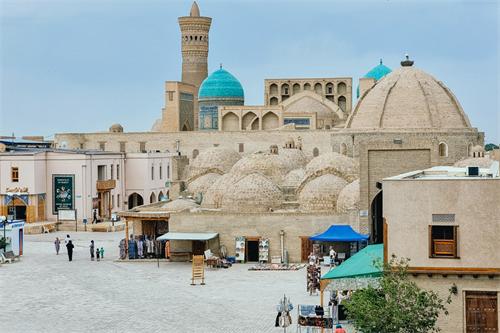
In the heart of the old city, you will pass through trading domes—typical Silk Road marketplaces that have now become a paradise for handicrafts. Silk scarves, ceramic pots, carpets, miniature Persian paintings, copperware, spices, glassware… each item speaks its own language. Haggling is a must—here, trade is not a cold transaction but a warm interaction.
Ark of Bukhara
One of the oldest structures in Bukhara, the Ark fortress was built in the 3rd century BCE. It houses a museum, and from the top, you can overlook the entire city. Sunset is the best time to visit. Once a royal palace, the Ark now stands in ruins, yet its broken walls evoke a powerful feeling. From its height, the entire old city is visible, bathed in golden sunlight.
Ticket: 40,000 UZS
Samanid Mausoleum
Built during the 9th–10th centuries under the Samanid dynasty, this is the oldest Islamic mausoleum in Central Asia. Made of brick with intricate openwork, it blends multiple cultural traditions. In 1993, it was listed as a UNESCO World Heritage site. The stratified ruins of the Ark—dating back to the 1st century BCE—reveal layers of Hellenistic, Sassanid, and Arab influences. Archaeologists liken it to a “Central Asian mille-feuille,” with fragments of murals depicting the Sogdian goddess Nana—evidence of the fusion of Buddhism, local pagan beliefs, and Islam.
Ticket: 10,000 UZS
Bolo Hauz Mosque
Built between the 18th and 20th centuries, its prayer hall features a spectacular dome supported by 20 intricately carved wooden columns. Once the royal mosque of the Bukhara Khanate, it is also called the “Mosque above the Pond,” referring to the nearby water reservoir. Standing beneath the double rows of carved columns evokes a sense of timeless awe.
Emir’s Summer Palace
One of Bukhara’s most beautiful palaces, located about 20 minutes north of the city center. It was the residence of Bukhara’s last Emir and is the only surviving palace of the rulers, covering 6.7 hectares. Named *Sitora-i Mokhi-Khosa*—“as bright as stars, as pure as the moon”—the palace is admired not only for its beauty but also for its historical significance. Its exterior may seem rough, but the interior craftsmanship is remarkable, showcasing exquisite taste and skill in design and decoration.
Ticket: 40,000 UZS
Nakshbandi Mausoleum
Located 12 km northeast of the city, the Nakshbandi complex is centered around the tomb of the Sufi saint Bahauddin Nakshbandi, including a mosque, madrasa, and burial sites of local rulers. The walls contain a “wishing stone,” believed to protect against disaster. Surrounding springs and fruit trees are considered sacred. This site is a pilgrimage destination, often called the second “Mecca” of the Sufi world.
Suggested Itinerary
Day 1: Core old city attractions—Ark Fortress, Poi Kalon Complex, Bolo Hauz Mosque, Samanid Mausoleum, etc.
Day 2: Chor Minor, Emir’s Summer Palace, Nakshbandi Mausoleum, and other outskirts attractions.
Transportation
- Samarkand → Bukhara: Bus ~60,000 UZS, 5 hours (departure recommended 9 AM); Train ~76,600 UZS, 1h 40m (book in advance via eticket.railway.uz).
- Tashkent → Bukhara: Train ~10,000 UZS, 6 hours; High-speed train ~3.5 hours, >400,000 UZS, tickets are limited and require advance booking.
Accommodation: Stay near the old city for easy walking access to major attractions. Choose a local-style guesthouse to experience authentic Uzbek culture and meet travelers from around the world. For sites outside the city, use taxi apps like Yandex Taxi.
Food Recommendations
- Chayxana Chinar: Famous for grilled meat and plov.
- Ayvan Restaurant: Located in a 19th-century building, serving traditional Uzbek cuisine in a luxurious setting.
Practical Information
- Language: Uzbek and Russian; translation apps recommended.
- Currency: Uzbekistani Som (UZS), USD can be exchanged.
- Best Time to Visit: Spring (March–May) and Autumn (September–November), when the climate is pleasant.
Bukhara, a city that flourished for over two thousand years along the Silk Road, is imbued with history. Compared to the bustling Samarkand, Bukhara is best explored slowly, like flipping through a thick, gentle book, with every page telling a story. Here, majestic minarets coexist with everyday warmth, scholarly depth with Afanti-like humor and wisdom.
Walking through Bukhara’s streets, you are not merely traveling—you are traversing a thousand years of time, listening to the echoes of history.
Recommended for you: